
The Role of Play in the Mental Health of Children
There’s a closer link between play and child mental health than you might realize. As more and more people begin to question the necessity of recess and free play for kids, behavioral professionals are examining the effects playing has on child development. The results clearly show that play isn’t a frivolous activity, but a crucial one for kids’ well-being.
Playgrounds, either in schools or community parks, can be the stage for encouraging kids to take the steps toward a healthy, well-balanced life, including one with better mental health, improved cognitive function and well-rounded social relationships.
Read the full article or jump to a specific section:
- Free Play and Mental Health
- How Play Improves Mental Health
- Improve Your Playground for Outdoor Play
- Contact Miracle Recreation to Upgrade Your Playground
Free Play and Mental Health
Stress is an inevitable part of life, and there is such a thing as positive stress. Positive stress is the kind that results from things like the desire to do your job well or from experiencing a pregnancy. A little bit of positive pressure is healthy, but when it becomes negative, it can lead to long-term health problems. The ability to differentiate between positive and negative stress develops early, and free play has a part in it for kids.
Promoting Positive Feelings
Play isn’t merely a chance for kids to relax. Research on children’s play shows that it has numerous benefits, the most obvious being that it promotes positive feelings. Kids whose parents allow and encourage them to indulge in unstructured play tend to be happier and feel better about themselves. This increase in positivity has shown to reduce the occurrence of undesirable behaviors, such as bullying.
Unstructured play allows kids to self-regulate and learn to deal with the gamut of emotions, including anger and frustration. It also helps kids be more resilient as schoolyard games and interactions let them become more emotionally aware, able to cope with stress and disappointment and manage challenges. Resilience is crucial for kids’ long-term mental health, especially when it comes to managing stress or dealing with conflict.
Kids who come from unhappy homes or are facing other adversities benefit even more from unstructured play, since it’s an opportunity for them to relieve some of their negative stress and develop coping mechanisms to wade through their troubles.
Developing Healthy Relationships
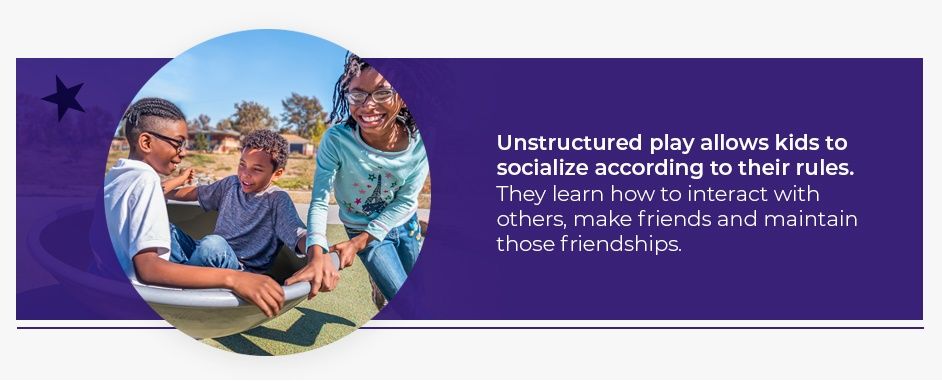
Unstructured play allows kids to socialize according to their rules. They learn how to interact with others, make friends and maintain those friendships. Play has shown to increase emotional attachments in kids, since it helps them develop their social competence. And they do so with the help of a healthy brain, which gets healthier the more kids get to indulge in unregulated play.
Secure relationships are also crucial for kids’ long-term mental health, allowing them to feel more positive stress, which, in turn, helps them navigate their problems later in life. Kids living in poverty or in dysfunctional homes especially benefit from secure relationships developed during play, especially if they don’t have an adequate support system elsewhere. Emotional support from friends is another way for kids to learn to cope with their adversities healthily and productively, leading them to be less likely to experience mental health issues as they grow.
Cooperation and compromise are two skills kids develop through unstructured play. When self-regulated, kids learn to work as a team and become more self-aware. With self-awareness also comes the ability to empathize with others and practice compassion. This social inclusion promotes a greater sense of belonging, support and purpose — essential qualities for maintaining positive mental health.
How Play Improves Mental Health
More than 260 million people suffer from mental health disorders — including depression — and those symptoms often start in childhood. Engaging in regular unstructured time helps depression by giving kids the tools they need to help combat negative mental health effects.
- Physical activity boosts positive feelings: Most types of outdoor play involves some level of physical activity, which research shows has a positive impact on mental health because it increases natural endorphins and fosters higher self-esteem.
- Play teaches kids how to navigate conflict: Imaginative play gives kids the space and freedom they need to approach real-life situations on their terms. They can recreate conflicts and struggles in their playtime and learn how to reach a solution that helps them feel happier and braver when real-life situations arrive.
- It’s a good opportunity to expend energy: Kids may sometimes compartmentalize or hold in strong emotions, creating a pent-up supply of negativity, anger or anxiety. Active play is a great opportunity for kids to use these feelings in a healthy, controlled environment. When kids are free to express their emotions on their terms, they are less likely to engage in potentially destructive behavior.
- It establishes normalcy and promotes healing: Childhood is often a landscape of cliques, social stigmas or disruption — inclusive playgrounds are an equalizer. They provide each child, regardless of their abilities, a neutral ground where they can come together and make meaningful social connections, learn how to navigate social situations and find similarities with others while having fun.
Improve Your Playground for Outdoor Play
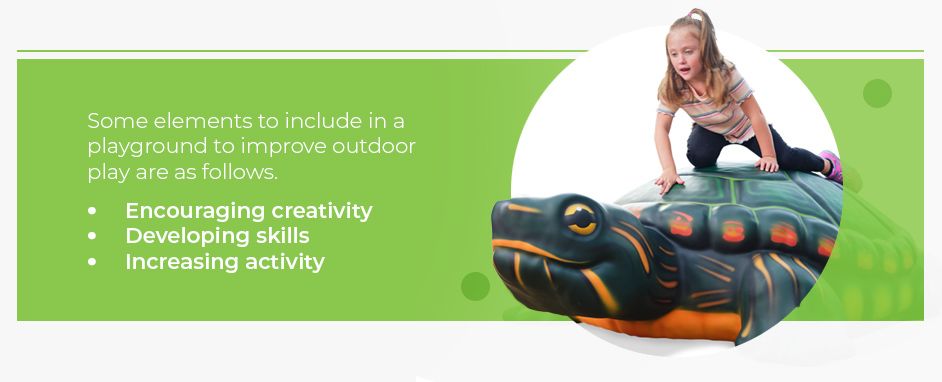
A playground is essential for kids to truly let their imaginations run wild. Elements of a good playground should help kids develop all the social, cognitive and physical skills they need to become well-adjusted, functioning adults. Kids should be able to feel like they have control without the fear of losing it. Some elements to include in a playground to improve outdoor play are as follows.
- Encouraging creativity: Whether it’s fantasy games or exploring their artistic sides, playgrounds should inspire kids to let their imaginations loose. This creativity is crucial for developing unique solutions to problems or conflicts, coping with stressful situations and alleviating stress.
- Developing skills: Playground structures are an excellent way for kids to see in action the theoretical concepts they learn about in class. Slides, swings and sandboxes all challenge kids to hone their cognitive skills. And incorporating structures that promote teamwork helps kids perfect their social and emotional skills.
- Increasing activity: Kids don’t go to the gym to exercise like adults do, so playing is how they get the exercise they need to stay healthy. Structures that encourage climbing, jumping and running are all great ways to get exercise while having fun. There are also play structures specifically designed to encourage fitness in youth, making them outstanding additions to your school or neighborhood playground.
Contact Miracle Recreation to Upgrade Your Playground
Encouraging kids to play is an essential part of their mental health and their overall development. That is why Miracle Recreation provides a large variety of playground equipment to help you build or upgrade your playground and make it the best. For years, we’ve worked to provide stimulating playground equipment that’s also long-lasting and reliable. And, we’re always working on new and innovative ways to encourage kids’ well-being without sacrificing the opportunity for creative free play.
If you are in the market for new playground equipment, browse our products today and request a free quote.